Filter topics1/12

Google is rolling out a Search Console toggle that lets website owners opt out of AI Overviews and AI Mode, starting with UK testing.
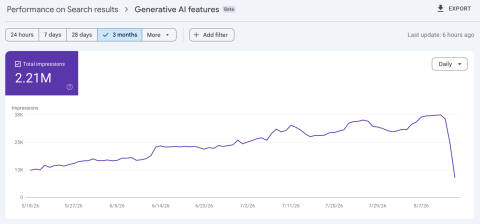
Google confirmed a logging bug in Search Console's Generative AI in Search performance report causing artificially low impression counts since August 13.
Google's research demonstrates that large language models struggle to recall facts when questions reverse the typical subject/object entity order.

Apple has expanded Applebot's infrastructure with over 4,600 new IP addresses to support crawling for Siri and Apple Intelligence.

SEOFOMO News reports that OpenAI's documentation suggests ChatGPT's Fetch Bot may not be bound by robots.txt restrictions, despite evidence of it accessing blocked sites.

Google's updated crawl budget guidance now recommends using 304 status codes for unchanged pages to help Googlebot allocate resources more efficiently.
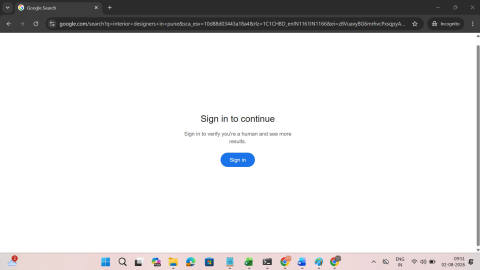
Google is testing a sign-in requirement for searchers to access additional search results, a move that could reshape how users discover and interact with organic content.

A federal judge dismissed Google's DMCA anti-circumvention lawsuit against SerpApi, ruling that publicly accessible search results and snippets are not copyrighted works Google can legally protect.

Fraudulent DMCA takedown requests are successfully removing legitimate original content from Google Search, exploiting a weakness in Google's verification process.

Google has rolled out its August 2026 spam update globally across all languages, with a multi-day rollout window.

Google is rolling out structural changes to EU hotel search results, introducing a multi-provider Hotel Multi-Pack and direct hotel website module in response to Digital Markets Act compliance requirements.

Google's Googlebot declares itself as coming from Mountain View, California, but actually crawls from various data centers worldwide depending on regional needs.

Google Search and News tabs experienced a bug preventing the 'Recent' filter from working, which was confirmed and fixed within hours.
Google is adding back button hijacking—a deceptive UX trick—to its explicit spam policies, opening sites that use it to manual or algorithmic penalties.
Google experienced a notable ranking volatility spike over August 12–13, while OpenAI began hiding ChatGPT source links behind additional clicks.

Misconfigured Cloudflare and CDN settings can accidentally block Google crawlers, causing sudden ranking drops and traffic loss.
SERoundtable's daily recap flags a Google ranking volatility spike from August 1–3, new Bing and Google tools updates, and platform feature changes.
Google has removed the requirement to block internal search results from indexing, but continued blocking remains advisable to avoid server load and quality issues.

Google's John Mueller says A/B tests with significant differences between variants may show visible effects in search results and indexing.

Google Search Console's URL inspection tool may display canonicals pointing to spammy sites, warranting closer review of canonical selections.
Gary Illyes clarified that hreflang alternate URLs are stored as variants rather than indexed pages in the traditional sense.

Google has formally removed the requirement to block internal search results from its guidelines, but John Mueller advises continuing the practice to avoid server load and quality issues.

Google's John Mueller and Martin Splitt discuss blocking internal search result pages to prevent infinite crawl traps and database overload.

Google's robots.txt recrawl feature in Search Console is throwing errors for multiple users, though the issue appears intermittent.
Google has updated its crawling infrastructure documentation with fresh recommendations for optimizing crawl budgets.
Google introduced a new spam policy on April 13, 2026 targeting back button hijacking, a deceptive practice that traps users on sites to boost ad impressions.
Google announced a new spam policy targeting back button hijacking, a deceptive practice that manipulates browser navigation.
Google's John Mueller suggests using country-code TLDs for international sites may be unnecessary and can complicate both site management and search engine comprehension.

Google Search Console now supports natural-language AI prompts for organic search analysis.

Google's Search Console sometimes designates spammy sites as the canonical URL for legitimate domains, though Google says the selection typically resolves within weeks.

Microsoft will retire Bing Webmaster Tools' legacy SOAP/POX APIs on August 31, 2026, requiring users to migrate to the REST/JSON API version.

Google clarified review snippet structured data guidelines to explicitly prohibit fake reviews and those with undisclosed incentives.

Google refreshed its crawl budget guidance to clarify that all sites start with the same conservative crawl capacity limit, which can expand automatically if demand and health metrics support it.

Google's Gary Illyes says sites are better off omitting lastmod dates in XML sitemaps entirely if those dates are incorrect or unreliable.

Google will support the HTTP QUERY method once the broader web ecosystem adopts it, per Gary Illyes.

OKF v0.2 now includes trust verification fields—claim origin, expiration, and attribution—though no major AI systems are reading it yet.

Microsoft confirmed it will add page and query-level filtering to Bing Webmaster Tools reports, closing a gap with Google Search Console's existing capabilities.

Google is testing a sign-in requirement as an alternative to CAPTCHAs to verify human searchers, though the test remains unconfirmed and unreplicable by most users.

Google renamed its NotebookLM user-agent from Google-NotebookLM to Google-GeminiNotebook to align with the product's rebranding to Gemini Notebook.

Google updated its StoreBot crawler troubleshooting documentation with clarifications on accessibility, robots.txt, IP blocking, and reprocessing timelines.
Google's help documentation now explicitly recommends using self-referential canonicals on canonical pages themselves.
Google formally added guidance to its canonical help document recommending SEOs include self-referential canonical tags on the canonical page itself.
Google has moved its crawler IP range files to a new location as part of ongoing documentation organization.

Google Search Console has added brand filters to simplify filtering and analyzing branded search queries.

OpenAI updated its crawler documentation to clarify that its user-agent string version number may change and that it uses an additional robots.txt marker when fetching robots.txt files.

Google removed its OpenTable help document from Maps support but confirmed the partnership remains active after documentation consolidation.

Google removed an erroneous semicolon from its Google-InspectionTool user agent string documentation that didn't match the actual production value.